Rabu, 16 Maret 2016

Finding the Top of a Major Swing

The hardest thing for me to do as you will know if you are a regular reader of this blog is to hold onto a trade. I've been working on this issue for the whole of my trading life.

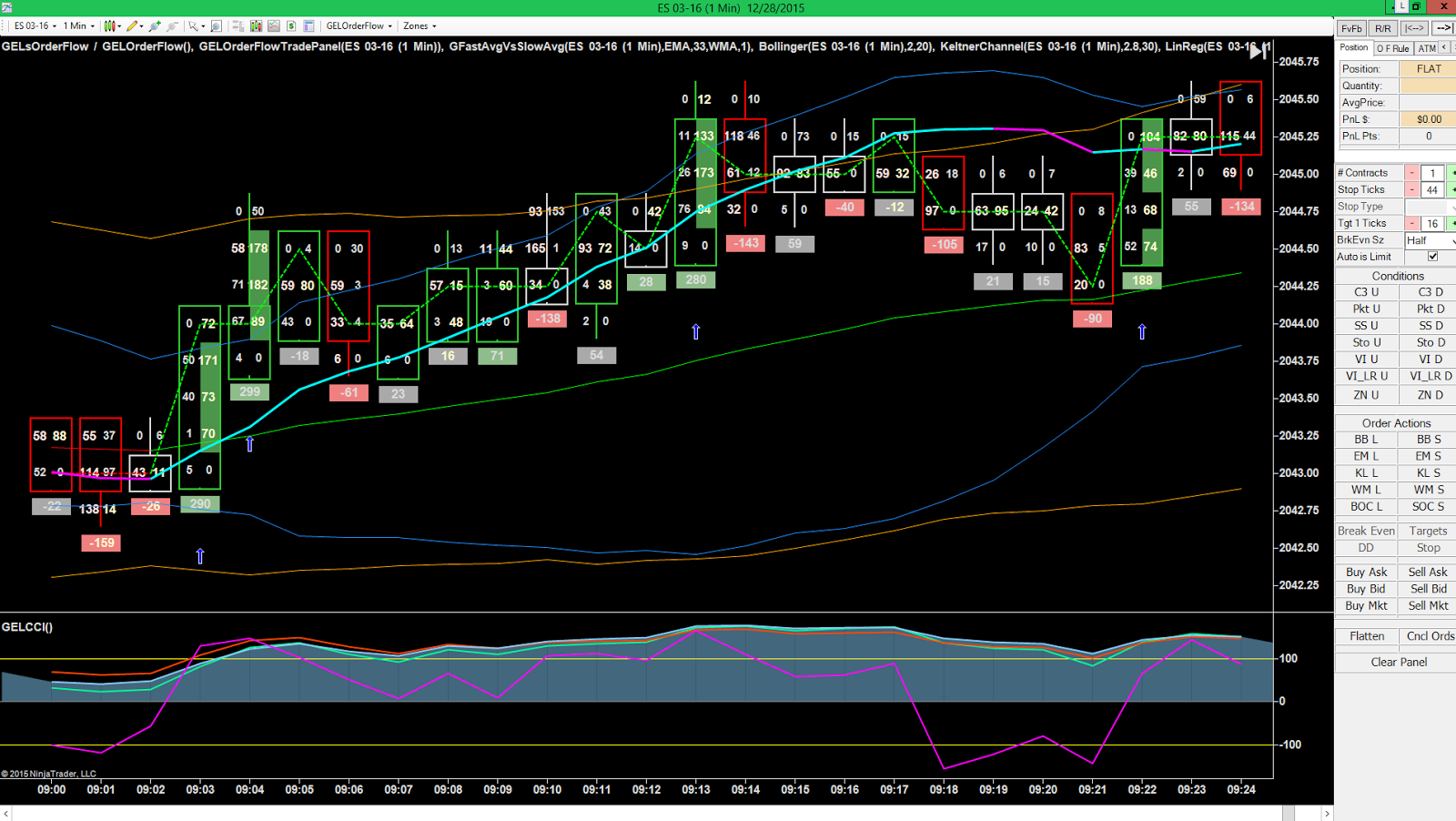
The charts below show how such a major top or bottom can be found. Its a matter of using order flow at the right context spots. The bar charts shows the latest tools I use. The buttons at the top of the chart allow me to have Flo trigger trades that meet most combinations of context and order flow combinations. The human eye is still needed as yet to verify the context. The second chart - Market Profile - shows the split's POC that held the market twice. The bar chart shows the reversal of the order flow at the right context for that chart. All that is needed is to have enough contracts so you can scale out at relevant chart areas.


Senin, 07 Maret 2016

Why Algos Work!

One of the reasons that algos for hybrid trading work so well is that it makes me focus on what's important and to ignore what's not.

Recent studies, talked about here, show that if you know what to ignore you can focus on what's important. The article is well worth a read.

Applying that to trading means that I create a trading plan and then strengthen my ability to stick to that plan by having an algo do the triggering based on the rules in my trading plan but only after I arm it for each specific trade after I have determined that the extra context components of the TP are present.

This means I have plenty of time before the trade triggers to arm my algo and then let it shoot the order with just 1 ms of latency when all the rules are met.

As the Great One said, "how sweet it is".

Jumat, 04 Maret 2016

Numbers and Orderflow and Algos

Writing this waiting for the monthly unemployment numbers.

The pic tells the story. Selling revealed itself after the market went overbought. It sold all the way down to the POC of the day's Volume Profile. I've been doing a lot of work on using Volume Profiles intra day and I'll be showing more about that. We've got a lot of information about order flow in our data stream and we have the technology to reveal the information we need to trade CP. Its now just a matter of learning how to use it. We're in very competative markets. We are competing against a lot of smart people and HFTs. Using algos is a must for most of us if we are to succeed.


The markets liked the number, at first but over cooked it. Then the opportunities showed themselves. The buttons at the top of the chart allow me to place trades based on a combination or orderflow and context. Go Flo.


Minggu, 28 Februari 2016

Scalping and Short Term Trading is Like Jujitsu - Using the HFTs to Profit

As these markets continue in their transition, one think looks like it will remain a permanent part of trading: the algo. There's algos and there's HFTs. While a retail trader can't be an effective HFT, we can use algos and we do.

This leads me to Jujitsu. The Wikipedia here says:
Jujutsu (/ˈts/ joo-JOOT-soo; Japanese: 柔術, jūjutsu About this sound listen ) is a Japanese martial art and a method of close combat for defeating an armed and armored opponent in which one uses no weapon or only a short weapon.[1][2]"" can be translated to mean "gentle, soft, supple, flexible, pliable, or yielding." "Jutsu" can be translated to mean "art" or "technique" and represents manipulating the opponent's force against himself rather than confronting it with one's own force.[1] Jujutsu developed to combat the samurai of feudal Japan as a method for defeating an armed and armored opponent in which one uses no weapon, or only a short weapon.[3] Because striking against an armored opponent proved ineffective, practitioners learned that the most efficient methods for neutralizing an enemy took the form of pins, joint locks, and throws. These techniques were developed around the principle of using an attacker's energy against him, rather than directly opposing it.[4]

The part of the quote printed in bold above was emboldened by me to highlight the main idea I'm talking about: "use an attacker's (HFT's) energy against him.

In previous posts I've talked about seeing the order flow. Its something that has been the focus of this blog since its beginning in what seems a lifetime ago now, October 2009.

On the floor our function was to take the other side of the trade of the "paper". We were liquidity providers. However, where we differed from market makers was that we only took the other side of trades that we wanted to take. So if, say, we identified a broker coming in with what looked like a big buy order, the smart thing to do was to sell him the last 100 contracts. In addition, we may have also front run his order, buying ahead of his big order and selling to him as he filled his order pushing price in our favour.

No more floor locals.

But we have something now that we didn't have then. We can count the volume contract by contract and see whether the buyers or the sellers were more anxious.

The nub of all this is how to use the technology we have now to trade the way we did on the floor. We had an enormous edge on the floor and this edge is here now, using the right technology and the right strategy.

Traders are looking for a way to use a relatively low amount of capital with limited risk per trade and the ability to make a living trading small size. "Using an attacker's energy against him" is the way to do it.

More to come on this subject.

Jumat, 22 Januari 2016

Stress and Trading

I just came across a webinar delivered by a psychologist, Dr Andrew Menaker, for my friends at MarketDelta about 18 months ago.

This is probably one of the most interesting takes on trading psychology I've seen since Mark Douglas' work.

You can see it here.

If you know your enemy.....

Selasa, 19 Januari 2016

Seeing Orderflow Change to Sell where I Expected It.

As I have said so many times - Context Rules. The pix below shows the bigger picture first: The market traded a swing down and then retraced - our typical pullback in the direction of the trend. While we used to just use the CCI to track this we can now use orderflow. The indicator is the Logik Volume Wand which creates the Volume Profile of the swing. There is also the VWAP there. The second pic is a close-up of where the trade triggers. As I said, there was a swing down and then a retracement. The retracement went to the POC of the swing and right below the VWAP - VWAP is the average value of the swing. The red arrow shows orderflow changing from buy to SELL and this is the trigger.

The context is very important as orderflow changes direction often and often without follow through. What is different here is that the context says that if the orderflow changes direction at the POC or VWAP then there is a good enough probability that there will be a big enough move in the direction of the change. The next piece is the trade management: stops and targets. This last piece of the trade is a very big part of being CP.


Sabtu, 16 Januari 2016

It Just Got a Lot Better - My New Tools.

I thought the beginning of 2016 would be a good time to share where I am now in my trading. Let me be clear, the basis has not changed. I trade inside out trades by trading the pullbacks in the trens as well as outside in trqades fading overbought and oversold conditions, all in a Market Profile context.

Lets start by talking about where Pete Steidlmayer is now. Here. Pete talks about trading the swings between accummulation and distribution. He tracks VOLUME. Now that actual live volume is available, he says that TPOs are outmoded. While I don't totally agree with that as I believe that Market Profile provides both support and resistance information as well as a big picture information of where value is moving, I do agree that we now are able to rtrack volume on a much more granular scale.

I tried using Pete's Volume Strips that he refers to in the video when they first became available, but I did not "see" the order flow clearly at all.  I then tried to use Pete's Cap32 software and had a guide with me for a week. Sadly, this did not add anything to my seeing order flow. Perhaps it was just me.

What began to provide me with more information was firstly cumulative volume delta and then MarketDelta's Volume Imbalance charts. Finally, the order flow was becoming visible.

What I have now done is to capture both the order flow and volume information to trade the same way I did before in order to more precisely see my entry and exit points. You still see the CCI to measure trend as well as Keltners and Bollingers to identify overbought and oversold. What is additional is the inside the bar trades and the Volume Profile (VP) to understand the order flow in each swing and to identify, more precisely, my entries and exits (stops and targets). These changes to my chart have provided a huge improvement, especuially in the types of markets we are trading in this modern eara where:
  • there are no floor locals - everyone is an electronic local
  • Algos make up for a great majority of the trades and volume that takes place every day in most markets
 So lets talk a few specifics. The VP identifies whether a pullback is a probable entry point or not. The VP also allows me to use tighter and better stops. To achieve this, I use multiple VPs on my chart as the swings develop.  The inside the bar information you see allows me to fine tune entries and to better identify exits.

The final piece is the buttons on the right I call GEL. These buttons allow me to hybrid trade and use specific rules in specific context whwre a set of pressed buttons are only valid for the particular trade I am attempting. They reset to zero after the trade is entered.


The Volume Profile is available from PureLogic. I'll provide more info on this great tool in subsequent posts. You can see the Volume Profile on any bars you select and shows, for that selection, VA, VAL VAH, POC, VWAP and Standard Deviations plus a lot more.You can buy it here.

Rabu, 13 Januari 2016

Algos for Hybrid Trading

For me, the optimum way to trade is hybrid trading: a mixture of algo and manual.

What this means is that I have an algo that I can turn on and off, and more. The more is that I have buttons for the different components of all my trading pictures and trade management and I can select which parts of which picture I want to use in a particular context.

I do not believe that its possible to achieve the same profitability with an algo as a proficient discretionary trader. However, with a hybrid algo I can achieve a larger daily consistent profit for less risk than discretionary trading of just one market.

It is not possible for me to program all of the context into an algo and that is why hybrid trading - turning on and configuring the algo for each trade - works best for me. You can see more about this in previous posts and pictures.

Selasa, 05 Januari 2016

Technology Wins! Algos Take First prize.

I saw an interesting article in this morning's Sydney Morning Herald here. My day starts with reading this newspaper, not only because its the newspaper I grew up reading but also because the international dateline is very near Sydney and the day starts there so by the time I wake up in Europe, the news has been well researched and written and I get a good summary of the day before.

What this article talks about is something that I started believing in 1979 or even before, that technical analysis is the only way to get a true idea of what is happening to a particular instrument in the market and that fundamental analysis is flawed due to latency and hidden information.

There can be no better technical analysis than orderflow and price action in context.Using algos to hybrid trade takes this approach to its logical conclusion. Not using algos to action and see the orderflow puts the trader at a significant disadvantage and at the other side of CP traders' trades.

Senin, 28 Desember 2015

Beating the HFTs

Its been estimated that the algos are responsible for almost 70% of the trading volume on futures markets. So as the pit locals disappeared as the pits were made redundant, the algos came in to take their place.

I've been writing about this transition for years and I think we have now come to the new normal although there will probably be more evolution due to regulation and technology changes. Most traders are still trading as if the old normal was still in existence.

Seeing the writing on the wall I started using hybrid trading also some years ago as chronicled in this blog. I defined hybrid trading as using an algo and turning it off and on and choosing different logic for a specific context. This is, I believe, what is required to beat the algos. The speed and reactions of an algo are needed to match the speed and reactions of algos if I want to win trading short time frames. Also, my algo can read and react to the order flow much quicker than a human can.

I have hybrid algos in MultiCharts, Ninjatrader and MarketDelta. The Ninjatrader version makes more efficient use of the PC's resources and now, with Ninjatrader 8, there are microsecond time stamps on each tick so that the order flow can be correctly followed. Each platform is better at something than another platform so it is a matter of using the one that best meets your needs in both functionality and ease of programming.

My algos use a button system that allows me to combine a number of conditions and rules with specific orders that will only execute when everything is true. The pic shows the completed Ninjatrader 7 version which requires tick recording. The Ninjatrader 8 version, is still being developed but has better volume capabilities in addition to correctly tracking order flow.

The functionality needed is a series of buttons that allows me to create a triggerable set of rules that shoot an order immediately those rule conditions are true. I watch the context and when I see the right context I arm a number of the buttons so that the algo can trigger the order from my Virtual Private Server that is co located at the exchange so that I get a less than 2ms latency from the moment that the conditions ar met and the time that the order hits the exchange matching engine.

The series of buttons decribe some context as well as order flow conditions. There are also trade management buttons so that I can have the trade management orders shoot out immediately I have a fill.


This type of functionality is available in a number of platforms out there now.

Sabtu, 19 Desember 2015

Nothing Has Changed Except Everything

If you go back to the beginning posts of this blog you will see that I emphasize that the math of your trading plan has to work or you can't be CP.

That has not changed nor can it ever. The three legs of the stool ate win rate, average profit and average loss. Those three metrics have to work to enable CP. However, there are many permutations and computations of these three metrics. basically, a high win rate allows a lower average profit. That's how scalpers make a living, keeping losses small too.

Remember, you can still be marginally CP if your win rate is just 35% as long as the win to loss ratio is 2:1 or greater.

That being said, if one randomly puts on a trade either long or short there should be a 50% chance of profit. If that is the case then just putting on a trade and having your stop loss marginally smaller than your profit target should make you CP as long as commissions are covered too.

So why do most traders find it difficult to get to CP? The answer has to be that they don't follow the trading plan. As someone who is also guilty of that sin more often than I'd like to admit, I understand the problem. If this is the issue then putting the majority of your effort into becoming more disciplined must be at the top of every trader's To Do list.

My focus for the last year has been to use technology to help me better execute my trading plan. Its not the latest indicator. Its not the latest methodology. Its just following order flow and managing my trade so the math can work.


Happy Holidays to everyone and I wish you all a profitable 2016.

PS. The everything that has changed is the markets. No Locals except electronic locals and lots of algo action. But its still just order flow.

Minggu, 22 November 2015

Getting to CP just by tweaking your stops and targets.

I want to revisit an oft mentioned topic that I wrote about back in the early days of this blog such as this post.

A critical part of a trading plan is the trade management. There are three legs to the stool of trade management that are important:
  1. the stop
  2. the target
  3. the win rate
The math has to work!

I have often said that a high win rate is important to me. That's a psychological dependency. So my trading style takes that into account.

For example, if I have, say, a 75% win rate then I can have a stop to target ratio of 1: 0.34 and be above break even. If I have a win rate of 34% then I can have a stop to target ratio of 1:2 and still be just above break even.

The math of this is critical for being CP. The style of trading doesn't matter but it needs to be created around these numbers.

So the starting point to your methodology is finding your trading pictures that will make you CP. As, say, a 34% win rate trader you can create a stat of average winners much more than twice your losses then you can make a good living.

If you are not CP then maybe its possible to get to CP by tweaking just this trade management portions of your trading plan. You may have the right entry strategy but are managing your exits incorrectly. But it requires discipline.

Selasa, 06 Oktober 2015

FDXM is Coming!

There will be a new listing om Eurex on 28 October, next. The miniDAX. It will be 1/5th the size of the existing DAX futures contract - 5 Euros a point: 2.50 a tick.

Those of you who have been around a while will remember when the ES was born out of the pit traded SP. And look what happened there. The DAX is an exceptional contract and I expect the new mini contract to become very popular due to its volatility.

https://www.eurexchange.com/exchange-en/resources/circulars/Equity-index-derivatives--Introduction-of-Mini-DAX--Futures/1976324


Kamis, 17 September 2015

How Sweet It Is!

My thoughts are often on the fun things I've experienced in the past. One of them was watching The Great One, Jackie Gleeson, with my Dad. I've posted about Jackie often in the past. "How Sweet It Is" was one of his sayings. When I'm disciplined in my trading which seems to be more often as I get older, how sweet it is.

Order flow in context. That's all there is to it. Today's first 75 minutes or so as a 1 lot trader. This could be any market: DAX, ES, CL, GC, 6E, ZB to name a few.

This 75 minutes in the DAX brought $600 plus on a 1 lot with no losers.


Senin, 14 September 2015

The Power of Context Order Flow Trading

Today's charts and trades show the first 90 minutes or so of the DAX using Context-Trader and its buttons.

The DAX started the day with a gap up and a sell off. It then found support at below the VAL but within the overlapping Profile's buying tail.

The 90 minutes ended with over $1,000 profit on a 1 lot initial entry using my DoubleDown trade management rules.

Order flow was very clear although some of the level 1 resistance points did not hold. This brought in the DoubleDown rules and resulted in no losing sequences again today so far. This is day 4 for me without a losing sequence.

I'm trying to show that you don't have to trade large size to make reasonable money once you have a good trading plan. Starting with a 1 lot size with DoublingDown is the way to start. Once you are CP on the minimum size, scaling SLOWLY up becomes a lot easier. The trap to avoid is to increase either too quickly or to a size where the outcome of any one trade matters.


Jumat, 04 September 2015

Order Flow Misunderstood + Consistency

Going through the websites of trading software vendors and trading education, I see that the words "order flow" have become a buzz word to sell. Sadly, most of what I've seen has little to do with what order flow really is.

Maybe I am being charitable, but perhaps the reason for this misinformation is that very few of these vendors or so called educators have actually traded order flow. The purest form of order flow was the live face to face trading that took place in the pits. In the pits, we were the market and what we did was the order flow.

Now, with electronic markets, traders are one step removed from order flow. We are all pushing orders into a bucket where they are electronically matched. Without that pit experience, this new type of order flow is much more difficult to understand. Looking at just what is traded on the bid and what is traded on the ask is not the answer as it misses the basis of what needs to be seen: the flow.

Markets continue in a specific direction until they don't. This up and down flow takes place on every time frame. A successful trader picks one of these time frames and trades the ebb and flow of the orders. That's how we make money consistently. Understanding how this ebb and flow happens and being able to see and track it is fundamental to being CP. There are three trade locations that are important to understand and to watch the flow move between them:

  • Over bought
  • Over sold
  • Mean
That's what we traded on the floor and that's what I trade today. Context-Trader and it's buttons allow me to be as quick and disciplined as I was on the floor. A trader needs to use every edge available to compete and the competition with the algos and HFTs is getting stronger.

I'm posting this morning's DAX trade on a 1 lot basis as I was doing a training session and wanted to demonstrate the consistency between today and the previous P&L post, both in money and in win rate and other stats. The credit goes to the methodology and the software tools I'm using. I'm posting not out of boastfulness but to encourage everyone to trade the real order flow not some mythical invention of people who have never traded it. 


Kamis, 03 September 2015

Context-Trader, Doubling Down and CP

In a post yesterday, I was asked about Context-Trader and doubling down.


Context-Trader is an add-in I had programmed that takes the different components of the context I use and puts that into buttons that you see in the chart. I can use many different combinations of those buttons, much like someone playing a piano, to meet the conditions I have in my trading plan for a trade. I can activate these buttons well BEFORE the trade is due to be triggered. That is to say, I see the context setting up and I arm the buttons to monitor that context so that when ALL the conditions are met, a trade is triggered. My trading charts are 1 MP chart and 1 bar chart with indicators that help define the context. When the context for one of my trading plan's trading pictures is setting up, I arm the appropriate buttons that will trigger the trade INSTANTLY at the moment that all my conditions have been met.

This is a manual discretionary process although by using the buttons I prevent myself from being able to take most non trading plan trades.

The platform runs on a VPS so the latency is only about 1ms. So I'm sitting on my mountain in France and I'm not impacted by the distance I am from the exchange. I also have something that reinforces my discipline and helps me keep to my trading plan. All of these things help keep me consistent.

I believe that this way of trading is a quantum change in discretionary trading. The win rate can be consistently as close to 100% as it was when I was a floor trader. While win rate is only part of what I need for CP, I know that it is very difficult to put on a trade unless you have one. Once I have a high win rate, all I have to do is manage the math and make sure my losers lose less than I make - trade management.

That's how we come to doubling down.

Expecting to consistently have a perfect trade location is a fool's errand. If a trade goes against me then I have two choices: stop myself out or find the correct spot to double down and improve my average entry price. The first choice means I lose money on a trade that could still be a good trade. The second choice allows me to stay in the trade and exit at either break even or at a profit.

Not all trades are suitable for doubling down. However, most of my trading pictures are trades that are suitable for doubling down.

I would not day trade without being able to double down. That's how important it is to my trade management.

The chart below has two real money trades that I did specially to show the power and confidence of doubling down. Both were exited at break even.


We now have the right technology that can get many many more traders to CP. Whether its MarketDelta, MultiCharts.net or NinjaTrader - I use all three with programmed buttons - a discretionary trader can become CP much more easily using it. The learning curve has flattened.

Rabu, 02 September 2015

DAX Trades this Morning

I was asked by a prospective student to show what trading can be done in a two and a half hour period trading just one lot so I thought I'd make it public. I started trading the DAX on the open and traded for two and a half hours with a coffee break part way through. The chart shows all the actual trades executed using real money and I've also added pictures showing the trades in my log and my P&L. The charts are MultiCharts.net and the log is from NinjaTrader. The trades were executed using my Context-Trader add-in and a scalping trading plan that I created.


The result was a profit of 812.50 euros (about $US900) less commission. If you look at the trades you'll see a number of double downs followed by scratches. This resulted in no losing sequences although a leg of the double down had a loss that was offset by the profit on the second leg.

This is fairly typical of this very short term trading plan. It can be done with increased size. I'll be trading the DAX afternoon U.S. RTH session for another 2 hours with my usual size.

Selasa, 01 September 2015

ContextTrader: Scalping

Lots of opportunities in these volatile markets. Today's short video is a scalp trade with a 1 lot DAX that earns 100 euros jobbing in and out using my programmed buttons in ContextTrader. It was the second trade of the day. I have various context programmed into the buttons. I am watching a bar chart with indicators for context as well as my split Market Profile chart. I then arm the buttons to take trades in the context I want using order flow. This trade is one from a scalping trading plan. Its a 1 lot trade so that you can see what can be achieved with just 1 lot. The red/green button at the top of the chart allows me to change size on the fly.

The trading plan reflected in the video is trading just 1 contract in the DAX can produce many trades every day with targets of from 100 euros to 300 euros, again depending on context. I devised this trading plan for a student. DAX is a great market with a 2500 day trade margin it can produce 100% a day using the Context-Trader buttons and this trading plan. There is no magic although the trading plan requires the Context-Trader buttons to execute it correctly.

Rabu, 26 Agustus 2015

Catching the Tradeable Highs and Lows

Its worth learning how to correctly split MPs as the splits reveal the real support and resistance. The S&R in today's DAX is a typical example. Then you've only got to find a way to hold the trade long enough. Scaling out is a good way.